Research

Three positions, in order.

01

Microwave Synthesis of MnO2 Nanoparticles

Independent Research Lab · Dec 2024 to May 2025
Dr. Alexander Kamasah · first research position

Manganese dioxide nanoparticles are of interest as a battery electrode material, and a one-pot microwave method reaches them faster and more cheaply than gas-phase or sol-gel routes. Students in the lab before me had run that method while varying only reaction time, and found that time had no effect on particle size. Yield stayed low. Pressure, temperature, ramp time, hold time, solvent, and quantity had never been tested, so that became my assignment.

I went through the literature to find the temperature and pressure ranges other groups were using, then ran four batches under different conditions, switching the solvent to ethanol. Each batch was checked by UV-Vis, since MnO2 nanoparticles are reported to absorb near 410 nm.

We never got that peak. However, the supernatant did show a peak near the right position while the solid we spun down showed nothing, which suggests the product was being lost in the wash rather than never forming at all. I was not able to resolve it before the project ended, and the results were inconclusive.

It was my first research position, and most of what it taught me was how to work in someone else's lab. Dr. Kamasah's advice has stuck with me: when the data starts to look good, you stay however long it takes to finish the experiment.
02

Reichardt's Dye as a Polarity Probe for Isooctane and Ethanol Fuel Blends

Introduction to Chemistry Research · Nov 2025 to Feb 2026
Dr. Rebecca DeVasher · five-person team

Racing fuel is mostly isooctane, which comes from petroleum. Ethanol is renewable and burns cleaner, so blending the two is an obvious route toward a more sustainable fuel. However, ethanol carries less energy per liter, so the real question is how much can be added before performance suffers. Our team set out to characterize isooctane and ethanol blends using Reichardt's dye, a solvatochromic probe whose absorbance shifts with the polarity of the solvent around it.

The probe did not work, and finding out why was the result. Isooctane and ethanol do not form a homogeneous solution. They separate into layers, and a polarity measurement taken across a biphasic mixture does not mean anything. We added 1,3-propanediol as an emulsifier, which failed to combine the layers and appears to have bound the dye itself, shifting the spectra toward the polar end. We also found the dye binds ethanol more readily than isooctane, so even the order the solvents were added in changed the reading.

Separately, theoretical calculations of atom economy and energy output favored higher isooctane content. That supported our hypothesis, but it also exposed the weakness in it, because by that metric alone pure isooctane wins, and pure isooctane is the thing we were trying to move away from.

As far as we found, this was the first time ethanol and isooctane had been probed with Reichardt's dye. The useful next step is an emulsifier that actually works.

03

Estrogen Receptor Binding Affinity by Fluorescence Polarization

Weatherman Lab · Feb 2026 to May 2026
Dr. Ross Weatherman · individual project within a team developing a novel antiestrogen

Estrogen receptor positive breast cancer is the most common form of breast cancer, and it is treated by blocking the receptor. Tamoxifen was one of the first drugs approved to do that, however resistance and side effects have pushed the search toward derivatives that bind more tightly. The Weatherman lab synthesizes those derivatives as theragnostic agents, which meant the lab needed a reliable way to measure how well a candidate binds.

I built a competitive fluorescence polarization assay to make that measurement. Coumestrol fluoresces on its own and binds the estrogen receptor, so it spins slowly while bound and quickly once displaced, and polarization falls as a competing drug takes its place. I titrated coumestrol against the receptor to find working concentrations, settled on 50 nM coumestrol with 100 nM receptor, and ran every sample in triplicate on a Horiba Fluorolog.

To check the assay rather than assume it, I ran ethinyl estradiol first and measured an IC50 of 6 nM, which matched published values. I then measured two fragments of agents in development: OHT-6C at 12 nM, which binds more tightly than the parent drug it derives from, and PS-1 at 92 ± 44 nM. As far as we found, PS-1 had not previously been measured by fluorescence polarization.

The OHT-6C curve needs to be rerun at lower concentrations to give a complete dose response.

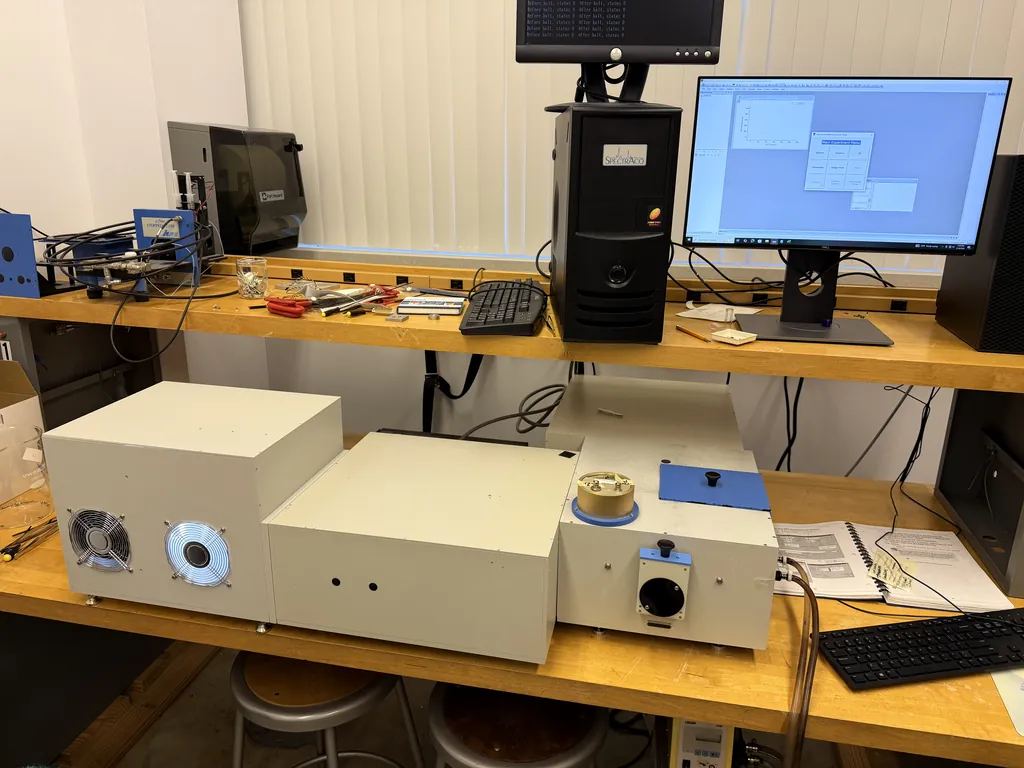
The Horiba Fluorolog spectrofluorometer on a lab bench, its control monitor on the shelf above.
Horiba Fluorolog Jobin Yvon · room M212, Rose-Hulman
Every measurement on this page was read on this instrument.

Open to research positions, internships, and conversations about drug delivery.